Search for 'Coir Brushes'

6 mins
2024-11-07
0
0
Copy Link
So, you have finally decided to minimise your carbon and environmental footprint. The first thing that pops into your mind, as you embark on this Ecoyaan, is purchasing an electric car. Sadly, when you go online, you realise that an EV costs 40% more than its petrol counterpart. Your dreams of living sustainably are shattered. Transitioning to an EV can happen later, maybe you’ll start with purchasing an eco-friendly t-shirt instead. No Nasties is an Indian clothing brand driven by sustainability; they use organic cotton that preserves soil health and plant 3 trees for every product sold on their website. Sadly, their t-shirt costs 2.5x more than the ‘Amazon brand’ counterpart, which is made using genetically modified BT cotton + polyester mix and epitomises everything wrong with the textile industry today.
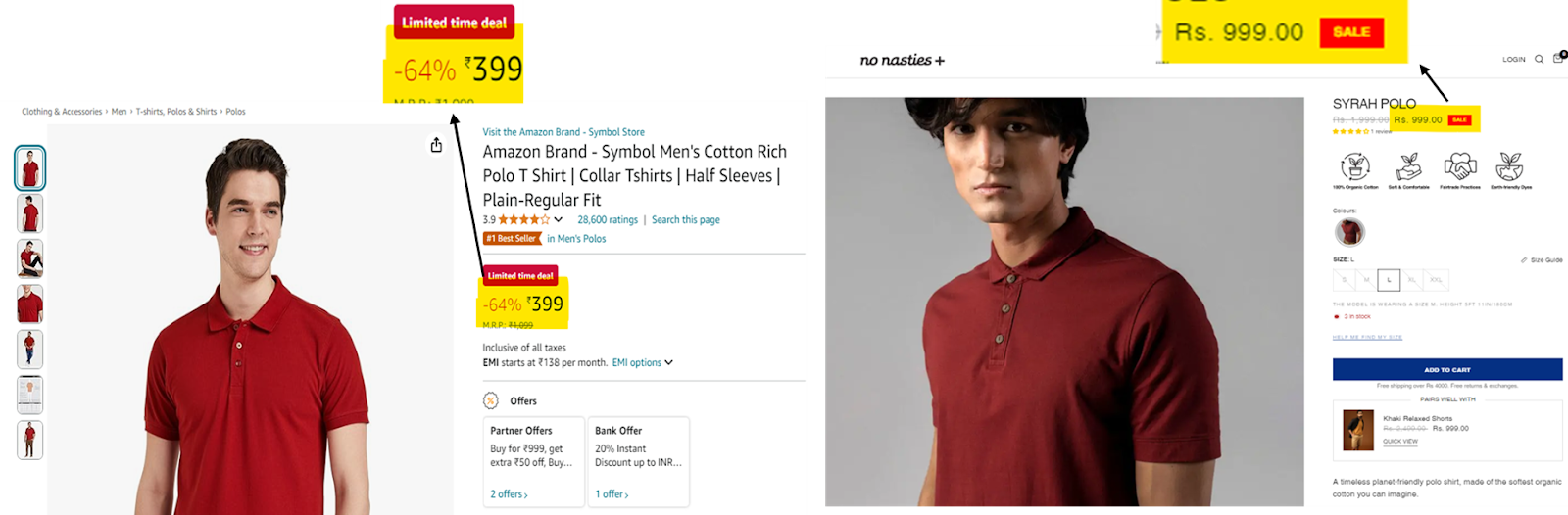
Source: Amazon.com(left) and No Nasties (right)
If money has come in the way of your sustainable life choices, you are not alone. According to a research study in the UK, 33% of the participants felt that eco-friendly living is not cost-effective. The higher price you pay for environmentally friendly items is also known as the ‘Green Premium’. Although this premium is real, there is more to it than meets the eye.
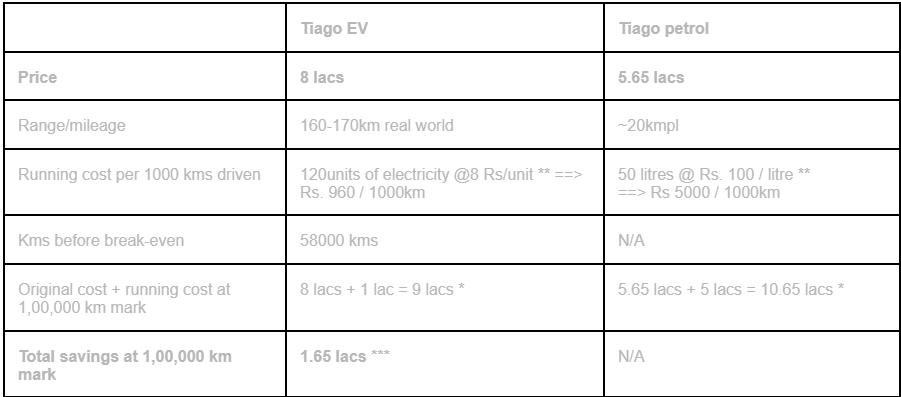
Take the EV example = Once we factor in the drastically lower running cost, buying a small EV can result in over Rs. 1.5 lacs of cost savings across the car’s lifetime, compared to a small petrol hatchback. See the reference table at the end of the article for our calculations.
Polo t-shirt example = Studies have shown how the fast fashion industry prioritises costs over quality, by using inferior raw materials and cheap unskilled labour. So, while the organic 100% cotton tee may last 10 years if kept well, the mass-produced garment may wear out in only 3-4 years. Eventually, buying a more expensive piece of clothing may end up saving you money over its lifetime. All this while reducing your carbon footprint.
Large corporations have swathes of researchers and scientists who curate the most impactful marketing and advertising campaigns to fool us into purchasing cheap, inferior quality products, all in the name of GDP growth and pleasing their shareholders. You must do your own lifetime cost assessment when embarking on your sustainability journey.
“Consumer engineering is the process by which advertisers and designers can artificially create demand, often by making older objects seem undesirable. Consumers are buying five times more clothing than they did back in the 1980s. In order to produce goods that fast, both the quality of the item and the quality of life for workers have to take a hit.” - Izzie Ramirez, a Vox.com reporter, who explained this in an awesome video here. Check it out.
Solar panels are the perfect example of how to think about the green premium. The cost of solar power has dropped drastically over the last decade. According to Hannah Ritchie, Deputy Editor at Our World In Data, across the last 50 years, the cost of solar panels has plummeted with increasing demand/capacity. That’s economies of scale!
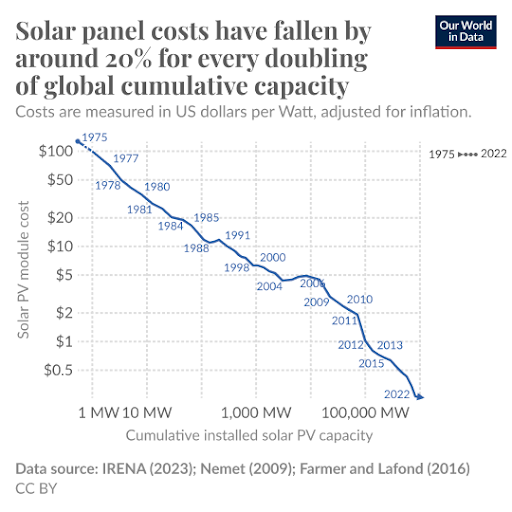
If you think about it, despite the astronomical costs in the early 2000s, some environmentalists signed up to install rooftop solar. Thanks to these early adopters, wind and solar power have now become the cheapest ways to produce electricity. So, for those who want to help with climate change, buying eco-friendly products can be a great way to do your bit. Maybe thanks to you, that organic cotton polo t-shirt will be the same price as a conventional product in 10 years!
“Not everyone can afford these (green) premiums, but if you can, it’s a productive way to contribute”
Do you really need four pairs of jeans in your wardrobe? Do you feel like you have too many children's toys in your home? Are you having to throw away food because you usually buy more than you need? Are you eagerly waiting for the launch of the new Samsung Galaxy or the iPhone, even though your current phone is doing great? If any of these are true, chances are you are buying more things than you need. You are probably spending more than you need to.
So far we have been talking about the cost of buying things. One of the best ways to live sustainably is to simply purchase fewer things. If sustainably grown/manufactured goods are being sold at a premium today, you can offset some of those higher costs by simply buying fewer things.

Photo by Bench Accounting on Unsplash
Recently, I have started rejecting merchandise at my workplace. I don't need another coffee mug or laptop bag. I have also started declining ‘1+1 free’ offers and any other ‘complementary’ items that companies dangle in front of us to retain our business in the long term. Sadly, our planet bears the bill for free stuff.
The answer is yes and no. It does cost more today to buy sustainably produced goods. However, these costs are bound to come down as demand for such items goes up over time. Moreover, supporting eco-conscious companies can be a good way to contribute to the climate movement. Secondly, planet-friendly items typically have a longer life and are cheaper to own and maintain, which saves money in the long run. Owning fewer things is one of the key principles of sustainable living which can also save you a lot of money. Finally, you’ll notice that sustainable living is not only eco-friendly but also pocket-friendly.
Reference table for EV/petrol vehicle running costs:

7 mins • 2026-06-02

5 mins • 2026-05-20

6 mins • 2026-04-18

6 mins • 2026-03-31

5 mins • 2026-01-23
5 mins • 2026-01-21
0
0
Copy Link
to write a comment.